How to Track Overtime Fairly (Without Spreadsheets or Guesswork)
Learn how to track overtime fairly with a clear policy, threshold, and approval flow. Stop disputes with automatic overtime detection instead of guesswork.
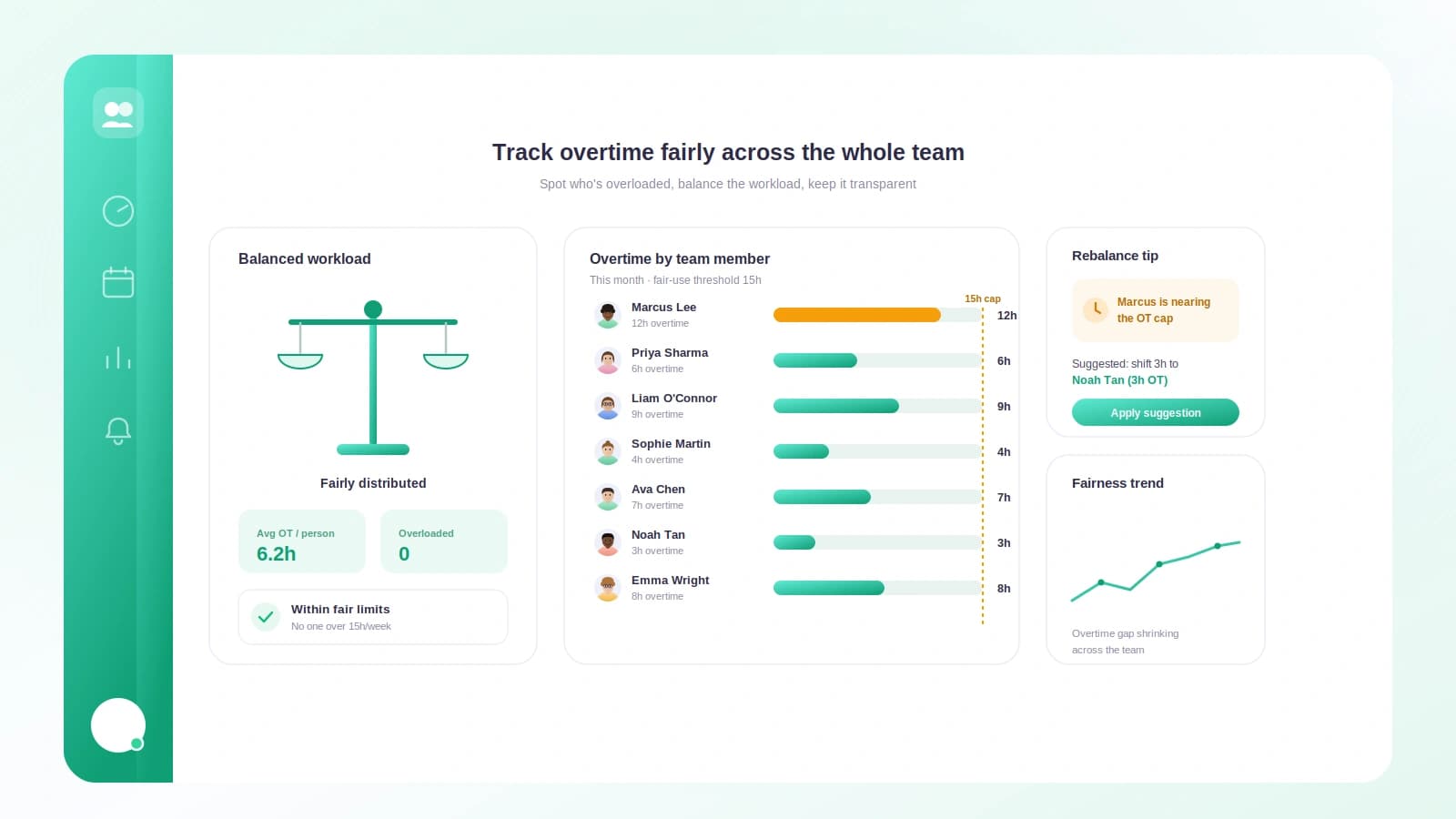
Two managers, same week, same team. One approves eleven hours of overtime because "everyone was slammed." The other approves zero because "nobody asked me first." Payday arrives, the two employees compare notes, and now you have a fairness problem that has nothing to do with how hard anyone worked.
That is the real issue with overtime. It is rarely about the hours. It is about whether people trust the way the hours were counted.
TL;DR
- Overtime disputes usually come from unclear rules, not lazy or dishonest people.
- Pick one threshold, write it down, and apply it identically to everyone.
- Combine a light pre-approval step with a weekly review of what actually happened.
- Automatic detection beats memory and self-reporting because the same rule runs on all logged time.
- Keep a visible record each person can check before payday, and most disputes disappear.
Why manual overtime tracking breeds disputes
When overtime lives in a spreadsheet or a manager's head, three things quietly go wrong.
First, the rule bends. A tired manager on Friday rounds differently than a fresh one on Monday. Nobody means to be unfair, but inconsistency reads as favoritism.
Second, the math is invisible. If an employee cannot see how their 43 logged hours became 3 hours of overtime, they cannot check it. They just receive a number and either trust it or resent it.
Third, memory fails. Self-reported overtime asks people to recall, weeks later, that they stayed late on the 12th. Some remember generously. Some forget entirely. The quiet, reliable person almost always undercounts.
None of this shows up as a formal complaint. It shows up as a slow drip of "is this place fair?" that costs you good people.
Start with a written overtime policy
You cannot track overtime fairly until you have decided, on paper, what overtime is. A short policy beats a long one nobody reads. Yours should answer four questions.
- What is the threshold? Daily, weekly, or both. For example, anything over 8 hours a day or 40 hours a week.
- Does overtime need approval? Yes for planned overtime, plus a weekly review for the rest.
- How are breaks handled? State which breaks are paid and which are subtracted before overtime is calculated.
- What is the pay rule? Even if a law sets it, write it down so nobody guesses.
Thresholds vary by country and contract, so anchor yours to your local rules. The concept of a standard working week and premium pay beyond it is common worldwide; the eight-hour day is a useful reference point for how these limits developed. Once you have the pay side settled, our guide on how to calculate overtime pay walks through the actual multipliers and math.
Set a threshold everyone can see
A threshold only works if it is the same for everyone and visible before the pay run. The goal is that any team member can open their own record mid-week and predict their overtime without asking you.
That means the threshold has to be a number in a system, not a judgment call. "A lot of hours" is not a threshold. "Over 40 in a week" is.
Build a simple approval flow
Approval is where fairness gets tested. Too loose and overtime creeps; too rigid and people work unpaid because they did not want to file paperwork. Aim for two lightweight layers.
Pre-approval for planned overtime
When someone knows a deadline will run long, they flag it in advance. A quick message is enough. This sets expectations and prevents surprise costs.
Weekly review for actual hours
Real work does not always announce itself. Someone stays late to fix a live issue. So at the end of each week, you review logged time, confirm the flagged overtime, and approve any genuine extra hours that were not planned. This second layer is what keeps honest people from losing hours they truly worked.
Automatic detection versus self-reporting
Here is the fork in the road. You either ask people to report their own overtime, or you let the system detect it from the hours they already logged.
| Approach | How overtime is found | Consistency | Best for |
|---|---|---|---|
| Self-reporting | Employee remembers and submits | Low, varies by person | Very small, high-trust teams |
| Manager tally | Manager reviews and counts | Medium, varies by manager | Teams with one steady reviewer |
| Automatic detection | System flags hours past the threshold | High, same rule for all | Any team that wants consistency |
Automatic detection wins on the one thing overtime needs most: the same rule applied to everyone, every week, with the math shown. It does not replace judgment. It just makes sure the starting numbers are honest, so your weekly review is about context, not arithmetic.
A worked example
Let's make it concrete. Meet Dana, a support lead on a team with a 40-hour weekly threshold and a 1.5x overtime rate.
Dana's logged week:
- Monday: 9 hours
- Tuesday: 8 hours
- Wednesday: 10 hours (a product outage ran late, flagged in advance)
- Thursday: 8 hours
- Friday: 9 hours
That is 44 logged hours. But Dana took a 30-minute unpaid lunch each day, so 2.5 hours come out first.
Step 1. Paid hours: 44 - 2.5 = 41.5 hours.
Step 2. Regular hours: 40. Overtime: 41.5 - 40 = 1.5 hours.
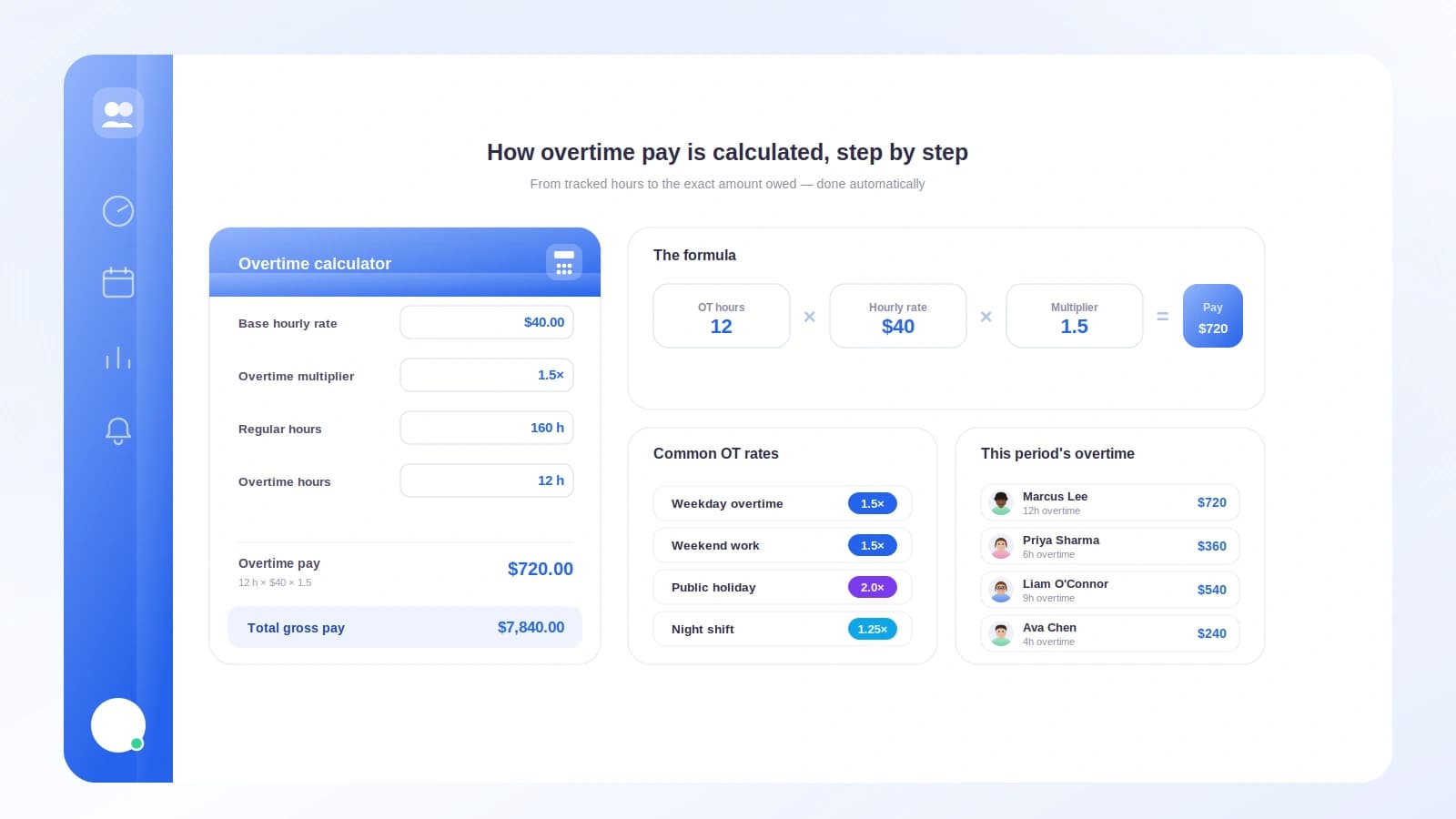
Step 3. If Dana earns $20 an hour, overtime pays 1.5 x $20 x 1.5 = $45 on top of regular pay.
Now notice what happened. Dana's Wednesday looked dramatic, but after breaks the whole week only produced 1.5 hours of overtime. A manager eyeballing "that was a rough week" might have approved four or five. The system counted the truth, showed the breaks, and Dana can verify every step. That transparency is the entire game. If you want to see how breaks change these totals, our piece on whether breaks count as hours worked goes deeper.
Keep a record people can check
Fairness is not just being fair. It is being seen to be fair. Every overtime number should trace back to logged hours anyone on the team can open and read.
A good record shows:
- Daily hours in and out
- Breaks subtracted
- The threshold applied
- Overtime hours and pay
- Who approved it and when
When that record exists and is visible, disputes stop being arguments and become quick fact-checks. When it does not exist, every disagreement becomes your word against theirs.
How Tickin tracks overtime fairly
Tickin was built so you never have to reconstruct a week from memory. People clock in and out from Slack, Microsoft Teams, or the optional desktop tracker, and their hours land in one timesheet automatically.
You set your threshold once. Tickin then applies it to everyone the same way, subtracts unpaid breaks before it calculates, and flags overtime the moment logged time crosses the line. No spreadsheet, no rounding by mood. Managers get a weekly view to approve flagged and unplanned overtime in one place, and every employee can open their own record and see exactly how their total was reached.
That combination of automatic detection and a visible record is what turns overtime from a monthly argument into a two-minute review. You can try it with your own team on the free plan for up to 10 employees before you decide.
Bringing it together
Tracking overtime fairly is not complicated, but it is deliberate. Write one clear threshold. Apply it to everyone. Add a light pre-approval step and a weekly review. Let a system detect overtime from real logged hours instead of asking memory to do the job. Then keep a record every person can check.
Do those five things and the fairness problem from the start of this article never happens, because both managers are working from the same visible numbers. If you are still deciding how to capture those hours in the first place, read our guide on time tracking for small business next, and start for free to see fair overtime tracking run itself.
Frequently asked questions
What counts as overtime?
Overtime is time worked beyond a threshold you set, usually a daily or weekly hour limit. The threshold should match your local labor rules and be written into your policy so everyone applies it the same way.
Should overtime be approved before or after it happens?
Both. Ask people to request extra hours in advance when they can, but also review actual logged time weekly. Pre-approval sets expectations, and the weekly review catches the real work that ran long.
Is automatic overtime detection better than self-reporting?
Automatic detection is more consistent because the same rule runs on everyone. Self-reporting still matters for context, so the best setups combine automatic flags with a quick human approval step.
How do I stop overtime disputes?
Write down one clear threshold and approval rule, track hours the same way for everyone, and keep a visible record each person can check. Most disputes come from vague rules or numbers nobody can see.
Do breaks affect overtime totals?
Yes. Unpaid breaks are subtracted before overtime is calculated, so a long lunch can move someone under the threshold. Decide upfront which breaks are paid and make sure your tracking handles them automatically.